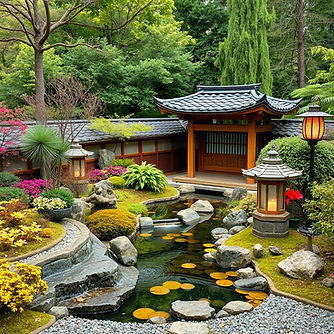
Zen Artistry in the Modern World

Japanese Gardens and Design
Key Elements and Design Features
Japanese gardens are renowned worldwide for their serene beauty, deep symbolism and harmonious balance with nature.
Unlike Western-style gardens that often emphasize symmetry and geometry (with clear axial paths, vibrant flower beds and
manicured lawns), Japanese gardens focus on simplicity, naturalism and quiet contemplation. The Japanese garden is more than
just a landscape — it is a type of quiet artistry rooted in Zen Buddhism, Shintoism and an aesthetic principle known as wabi-sabi,
which finds beauty in imperfection and impermanence. At the heart of the Japanese garden is a deep connection with nature.
While other types of gardens may aim to impress with grandeur or color, Japanese gardens aim to evoke feelings of peace,
contemplation, and reverence for the natural world. They are designed to inspire meditation and mindfulness, often embodying
principles from Zen Buddhism such as simplicity (kanso), asymmetry (fukinsei), and tranquility (seijaku).
1. Asymmetry and Natural Layout
Japanese gardens avoid strict symmetry. Instead, they strive for a natural, irregular balance that mimics real landscapes.
Rocks, trees, and paths are arranged with careful attention to scale and proportion, giving the illusion of a much larger,
untouched natural world. One important design principle is the rule of three which is used particularly in the placement
of stones, shrubs and trees. The goal is to create a natural type of asymmetry. The Rule of Three creates a natural visual
rhythm and a focal point in the garden, drawing the viewer’s eye gently from one element to the next in a contemplative way.
2. Stones and Rocks
In Japanese landscaping — especially in Zen gardens (karesansui, or dry landscape gardens) — stones and rocks are
the dominant visual feature. They are considered the foundation of the garden, and serve as both an aesthetic and spiritual
function. Rather than simply being decorative, stones are symbolic and represent elements of the natural world such as
mountains and islands. They can also convey a spiritual concept such as personal growth and transformation. Through
their texture, shape, and positioning, stones help transform the garden into a spiritual space, where the viewer can explore
the nature of reality, perception and self. Some of the better known Zen gardens in Kyoto, Japan include: Ryōan-ji, Daitoku-ji
and Zuihō.
3. Water Elements
Water plays a central and deeply symbolic role in the design of a Japanese garden, both as a visual and auditory element
and represents the constant flow of life and the purification of the spirit. Its use — especially in features like waterfalls —
adds movement, atmosphere, and depth to the garden's design. Ponds, streams and/or waterfalls are carefully integrated
to reflect the natural world. Some Zen gardens, especially those that are not strictly rock gardens, may include small
streams or ponds. The sound and motion of falling water are thought to cleanse the mind and spirit, preparing visitors
for contemplation or ritual (especially in temple or tea gardens). In Shinto tradition, waterfalls are considered sacred and
associated with spiritual purification. Also found in Japanese gardens are water basins (tsukubai) that are often found in
tea gardens.
4. Bridges and Pathways
Bridges and pathways are essential design elements in Japanese gardens, both practically and symbolically. They guide
the visitor’s movement, frame the garden’s scenery, and embody deep philosophical meanings tied to nature, journey, and
transformation. Bridges often symbolize a crossing over from the everyday world to that of spiritual transformation; from
one state of being to another. Bridges are visual focal points that add rhythm and contrast to the landscape. They may
be crafted from wood, stone, or earth, with forms ranging from simple planks to highly decorative arched structures. Paths
represent life’s journey — full of changes, detours, and moments of reflection. In tea gardens (roji), the path leads to the
teahouse and is part of the spiritual cleansing process before the conducting of a traditional tea ceremony.
5. Plants and Seasonal Awareness
Unlike Western gardens that may focus on constant bloom, Japanese gardens celebrate seasonal changes. Plants are
selected for how they express different times of the year — cherry blossoms in spring, maple leaves in autumn, mosses and
evergreens for year-round greenery. This enhances the garden’s role as a living, changing art form.
6. Lanterns and Pagodas
In Japanese garden design, lanterns and pagodas are traditional features that add a sense of timelessness and sacred
presence. They often serve as focal points and are placed with careful consideration to their surroundings and meaning.
Traditionally, lanterns symbolize light guiding the way, both literally and symbolically. Pagodas are miniature versions of
traditional Buddhist towers, symbolizing sacredness and eternity; echoing the presence of temples or mountain shrines from
a far-away place.
7. Enclosure and Framing
Many Japanese gardens are enclosed or framed by fences, walls, or plantings that separate the space from the outside world,
creating a sense of inward focus and tranquility. Views are often framed intentionally, much like a painting, through a technique
known as shakkei (borrowed scenery), where distant mountains or landscapes are visually incorporated into the garden design.
What sets a Japanese garden apart is not just its aesthetic, but as a spiritual setting for quiet contemplation. It is a carefully
curated space where art meets nature, and where every stone, plant, and pathway carry meaning. Designed to foster harmony
and mindfulness, Japanese gardens are quiet sanctuaries that remind us to slow down, observe, and find beauty in simplicity.
In this way, they are not just gardens — but living expressions of Zen artistry and Japanese culture.